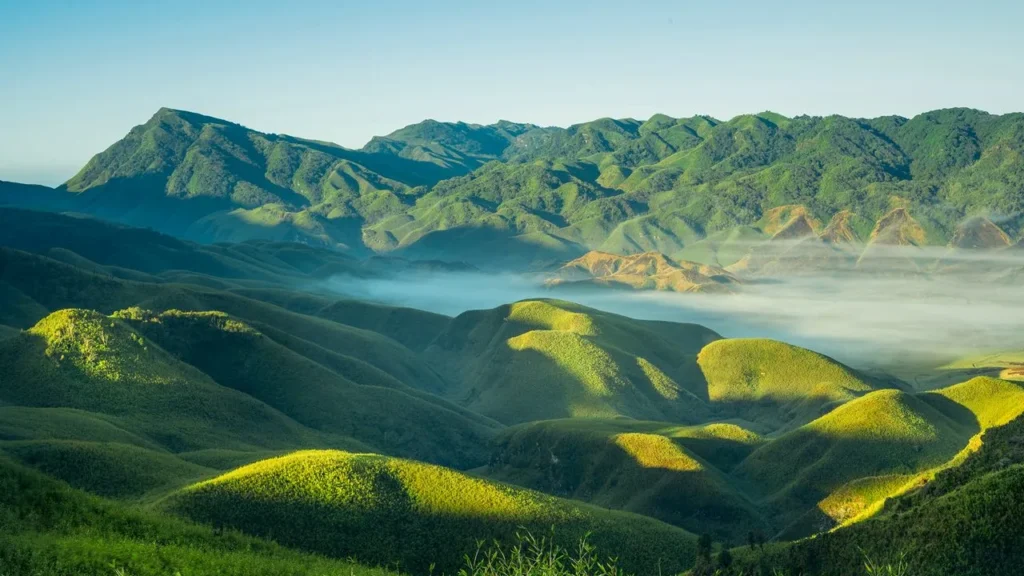
There are places that feel like murmurs from the earth. That is quiet, untouched, and impossibly beautiful. You know. Dzukou Valley is one of them. This high-altitude sanctuary is often called the valley of flowers, located between Nagaland and Manipur in India’s Northeast.
It is not just for its seasonal bloom but for the way it invites you to slow down and witness nature’s quiet artistry. At 8,045 feet above sea level, the valley extends out like a dream.
For trekkers and peace seekers, Dzukou Valley offers more than a walk. It is a passage into quietness. The journey begins with steep climbs and forested trails, but what awaits is a landscape. The peace from there feels like a painting come to life.
Whether you are chasing the bloom of the rare Dzukou Lily or simply seeking a break from the noise of modern life, this trek is a gentle revolt against speed is a chance to walk slowly, and feel the pulse of the hills.
The Trek: Routes and Difficulty
You know, what? There are two main routes to reach Dzukou Valley. Yes, one is from Viswema village and another from Jakhama. These two places are near Kohima in Nagaland. The Viswema route is longer but less steep. So don’t worry. This is ideal for beginners. The Jakhama trail is even shorter. But more challenging with steep climbs. Both routes meet at the valley’s edge, where the landscape opens up in a breathtaking reveal.
This trek typically takes 4–6 hours, depending on your pace and the route you have chosen. It demands stamina and preparation. The trails are well-marked but remote. So carrying essentials like water, snacks, and a first-aid kit is crucial. And what about the reward? Yes, you will be rewarded with a panoramic view of the valley of flowers. You know this view is where every turn feels like a secret unveiled.
Best Time to Visit
Yes. Timing is everything when it comes to Dzukou Valley. The best months are June to September. Why, because this is the time where the valley transforms into a floral wonderland. And you know what? July is particularly magical. The Dzükou Lily is found nowhere else in the world. It blooms in delicate pinks and whites across the meadows.
If you choose your own Winter. Then it offers a starkly different experience. The valley is often blanketed in snow, turning the landscape into a solid dream. While the flowers sleep, the silence deepens. If you are drawn to peace, then don’t mind the cold. These winter treks can be equally rewarding for you. Don’t miss it .But avoid the monsoon months, due to slippery trails and leeches.
Travel and Accessibility
To reach Dzukou Valley, your journey begins in Kohima. It is the capital of Nagaland. From Kohima, you can go on with shared taxis or private vehicles that can take you to Viswema or Jakhama. Then to the trek’s starting points. Kohima is accessible via Dimapur, which has the nearest railway station and airport. From Dimapur, it is a 3to 4 hour drive to Kohima.
Foreign tourists require an Inner Line Permit (ILP) to enter Nagaland. This can be obtained online or at designated offices. Indian citizens don’t need special permits but should carry a valid ID.
Stay Options: Camps and Shelters
Accommodation in Dzukou Valley is minimal but sufficient for trekkers. At the valley’s base, there is a government-run guesthouse with basic dorms and a few private rooms. You will need to carry your own sleeping bag and food. Even though simple meals like Maggi and tea are available there.
Camping is allowed, and many trekkers prefer to pitch tents near the guesthouse or along the valley floor. The experience of waking up in the valley of flowers, with misty wind around your tent. The silence all around is unforgettable for you.
In Kohima, you will find a range of hotels and homestays. From budget lodges to boutique stays. It is best to spend a night in Kohima before and after the trek to rest and acclimatise.
Expenses and Budgeting
Moreover, A two-day trek to Dzukou Valley can cost between ₹2,000 and ₹4,000. That too, excluding travel to Kohima. Must use Local transport from Kohima to the trailhead, which costs ₹500–₹800. Entry fees range from ₹100 to ₹200.
Staying at the valley guesthouse is around ₹300–₹500 per night, while food and snacks may add ₹200–₹400 daily. Tent rentals and optional guides cost extra. Typicallyit costs around ₹300–₹500 and ₹1000–₹1500, respectively. It is a budget-friendly trip with priceless views of the valley of flowers.
What to Pack
Must carry trekking shoes with a good grip. Pack warm clothes with you, as it is essential. The raincoat or poncho may be useful for you. Then carry Water bottles and purification tablets for better hydration. Snacks and energy bars is needful if you feel hungry in the meantime. A sleeping bag and Tent is important if you are camping. Most importantly, carry a torch, a power bank, and a basic first-aid kit with you.
Moreover, the valley has no mobile network. So inform someone before you go.
Summing up
At the end, when you walk through Dzukou Valley, it feels like stepping into a world that doesn’t rush. You know, it is a place where time stretches, and where the wind carries stories. Even the earth wears its heart in petals. The valley of flowers is not just a destination. It is a dreamworld.
Whether you are crafting a travel or craving for peace. Dzukou Valley reminds us that beauty lies in stillness. It makes you feel mini paradise. Eve, you can feel like the most powerful journeys are often the quietest ones.
So pack your bag, lace your boots, and follow the trail. The valley of flowers is waiting for you. It is not just to be seen, but to be felt. Do not miss this in your lifetime!!